Other Web 2.0 Technologies
Twitter
Doodle Poll
Eventbrite
Facebook
Screencast-o-matic
Monday, December 14, 2009
Wednesday, December 9, 2009
You too can YouTube
Within the past year online video hosting sites have exploded allowing users to easily to upload and share videos on the web. Among all the web 2.0 players in this area, YouTube is currently top dog allowing users not only to upload their own video content easily, but also embed clips into their own sites easily.
Within the past year online video hosting sites have exploded allowing users to easily to upload and share videos on the web. Among all the web 2.0 players in this area, YouTube is currently top dog allowing users not only to upload their own video content easily, but also embed clips into their own sites easily.
Do some searching around YouTube yourself and see what the site has to offer. You'll find everything from
1970s TV commercials
library dominos
Medieval IT Help Desk
Conan the Librarian
Of course, like any free site you’ll also find a lot stuff not worth watching too. But that doesn’t mean you shouldn’t explore and see for yourself what the site has too offer. :)
Medieval IT Help Desk
Conan the Librarian
Of course, like any free site you’ll also find a lot stuff not worth watching too. But that doesn’t mean you shouldn’t explore and see for yourself what the site has too offer. :)
Discovery Exercise:
Explore YouTube & find a video worth adding as an entry in your blog.
Create a blog post about your experience. What did you like or dislike about the site and why did you choose the video that you did?
Explore YouTube & find a video worth adding as an entry in your blog.
Create a blog post about your experience. What did you like or dislike about the site and why did you choose the video that you did?
Can you see any features or componets of the site that might be interesting if they were applied to library websites?
OPTIONAL: Try placing the video inside your blog using the copy and paste code for the for "Embeddable Player.” Note: you'll need to use Blogger's Edit HTML tab when pasting this code.
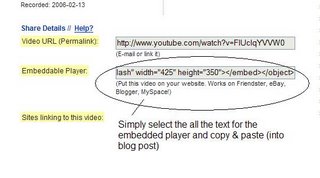
OPTIONAL: Try placing the video inside your blog using the copy and paste code for the for "Embeddable Player.” Note: you'll need to use Blogger's Edit HTML tab when pasting this code.
NOTE: Videos, like music downloads, are bandwidth hogs. You may have some trouble playing long clipsIf you have time, watch this old video I found on Youtube entitled "Do you want to be a Librarian?" Fascinating stuff... : )
...how things have changed...
...how things have changed...
Podcasts, Smodcasts!
The word podcast is used to refer to a non-musical audio or video broadcast that is distributed over the Internet. What differentiates a podcast from regular streaming audio or video is that the delivery method for podcasts is often done automatically through RSS.
Podcasting in Plain English: Another Commoncraft Youtube video which explains podcasting in user friendly terms.
In 2005, "podcast" was named the "word of the year" by New Oxford American Dictionary and with the growth of podcasting over the last three years, it's easy to see why.
Podcasts take many forms, from short 1-10 minutes commentaries (like the ones used in this Learning 2.0 program) to much longer personal interviews or panel group discussions.
There’s a podcast out there for just about every interest area and the best part about this technology is that you don’t have to have an iPod or a MP3 player to access them.
Since podcasts use the MP3 file format, a popular compressed format for audio files, you really just need a PC (or portal device) with headphones or a speaker.
There’s a podcast out there for just about every interest area and the best part about this technology is that you don’t have to have an iPod or a MP3 player to access them.
Since podcasts use the MP3 file format, a popular compressed format for audio files, you really just need a PC (or portal device) with headphones or a speaker.
iTunes, the free downloadable application created by Apple is the directory finding service most associated with podcasts, but if you don’t have iTunes installed there are still plenty of options.
For this discovery exercise participants are asked to take a look at some popular podcast directory tools.
Do some exploring on your own and locate a podcast that is of interest to you.
Do some exploring on your own and locate a podcast that is of interest to you.
Once found, you can easily pull the RSS feed into your Bloglines account as well, so that when new casts become available you’ll be automatically notified of their existence.
Discovery Resources:
There are many, many podcast directories and finding tools out there. Here are just three of the more popular ones that, unlike iTunes, don't require a software download:
BBC Podcast Directory
There are many, many podcast directories and finding tools out there. Here are just three of the more popular ones that, unlike iTunes, don't require a software download:
BBC Podcast Directory
Discovery Exercise:
Take a look at one or two of the podcast directories listed and see if you can find a podcast that interests you. See if you can find some interesting library related podcasts here like book review podcasts or library news.
Add the RSS feed for a podcast to your Bloglines account
Create a blog post about your discovery process. Did you find anything useful here?Can you see a use for podcasts in the library situation?
Audiobooks (or "The end is in sight ")
Downloadable eAudiobooks are becoming more popular in library situations.Subscription services such as Netlibrary and Overdrive enable libraries to purchase audio files, so library members can download them onto their mp3 players.The beauty of this is that after the loan period expires, the audio file is deleted from the mp3player.Wow...NO OVERDUES OR LIBRARY FINES
For this discovery exercise, you merely need to familiarize yourself a bit with the structure of the World EBook fair site (a free Downloadable eAudiobooks site)Take a look around and locate a few titles of interest.
Discovery Resources:
Discovery Exercise:
Create a blog post about your findings.
Tuesday, December 1, 2009
Discovering Web 2.0 tools


Throughout the course of this Learning 2.0 program we’ve explored just a small sampling of these Web 2.0 technologies that are empowering users with the ability to create and share content.
But given time there are so many more we could explore.
For this discovery exercise, participants are asked to select any site from this list of Web 2.0 Awards nominees and explore it.
With so many to choose from, it might be handy to first select a category that interests you (like Books or Personal Organization) and then simply select a tool/site to explore.
Be careful to select a tool that is Free and that doesn't require a plug-in or download.
The majority of these free, so this shouldn’t be a problem.
Discovery Exercise:
Select any site/tool from the list of Web 2.0 Awards nominees. (If you prefer to select from just the winners, here’s a link to the winners.)
Explore the site you selected.
Create a post about your discovery. What did you like or dislike about the tool? What were the site’s useful features? Could you see any applications for its use in a library setting?
If you are interested, here is a Web 2.0 tool Directory for you to explore- it is simply amazing what is out there, and evolving every second!Learning 2.0...exploring web 2.0 technologies through PLAY!
Web-based Apps: They're not just for desktops

The availability and use of online productivity web-based applications(eg: word processing and spreadsheets) has exploded over the past two years.
These powerful applications provide users with the ability to create and share documents over the internet without the need of installed desktop applications.
Some experts speculate that this emerging trend may mean the death to Microsoft Office and other software-based productivity tools, while others think web-based applications have their place, but not in the office.
But no matter which side of the office suite platform you side with, on this both sides seem to agree; web-based applications have their place.One large benefit to web-based applications it that they eliminate the need to worry about different software versions or file types as you email documents or move from PC to PC.
Another bonus is that they easily accommodate collaboration by allowing multiple users to edit the same file (with versioning) and provide users the ability to easily save and convert documents as multiple file types (including HTML and pdf).
And, you can even use many of these tools, such as Zoho Writer and Google Docs and spreadsheets to author and publish posts to your blog.
It’s this type of integration with other web 2.0 tools that also makes web-based apps so appealing.
For this discovery exercise, participants are asked to take a look at a web-based word processing tool called Zoho Writer, create a simple document and then document your discoveries in your blog.
If you're up to the challenge, you might even export your document as an HTML file or publish it through Zoho to your blog.With Zoho and web-based applications, the possibilities are endless.
Discovery Resources:
A short list of web-based productivity applications
Discovery Exercise:
1. Create a free account for yourself in Zoho Writer.
2. Explore the site and create a few test documents of two.
3. Try out Zoho Writer’s features and create a blog post about your discoveries.
Optional:If you're up for the challenge, try using Zoho’s "publish" options to post to your blog.* Note:
You can also explore Google Docs and spreadsheets Google's online word processer, as an option for this exercise.
"Sandbox" is the term that wikis often use to describe the area of the website that should be used for pure play.
For this discovery and exploration exercise, Helene Blowers at PLCMS has set up a whole Learning 2.0 Favorites wiki* that’s for nothing but play! Take a look around
Take a look at WikiNorthia
WIKIS
So what’s in a wiki?
A wiki is a collaborative website and authoring tool that allows users to easily add, remove and edit content.
So what’s in a wiki?
A wiki is a collaborative website and authoring tool that allows users to easily add, remove and edit content.
Wikipedia, the online open-community encyclopedia, is the largest and perhaps the most well known of these knowledge sharing tools. With the benefits that wikis provide, the use and popularity of these tools is exploding.
Some of the benefits that make wikis so attractive are:
Anyone (registered or unregistered, if unrestricted) can add, edit or delete content.
Tracking tools within wikis allow you to easily keep up on what been changed and by whom.
Earlier versions of a page can be viewed and reinstated when needed.
And users do not need to know HTML in order to apply styles to text or add and edit content. In most cases simple syntax structure is used.As the use of wikis has grown over the last few years, libraries have begun to use them to collaborate and share knowledge. Among their applications are pathfinder or subject guide wikis, book review wikis, conference wikis and even library best practices wikis.
Anyone (registered or unregistered, if unrestricted) can add, edit or delete content.
Tracking tools within wikis allow you to easily keep up on what been changed and by whom.
Earlier versions of a page can be viewed and reinstated when needed.
And users do not need to know HTML in order to apply styles to text or add and edit content. In most cases simple syntax structure is used.As the use of wikis has grown over the last few years, libraries have begun to use them to collaborate and share knowledge. Among their applications are pathfinder or subject guide wikis, book review wikis, conference wikis and even library best practices wikis.

Use these resources to learn more aboout wikis:
Wiki, wiki, wiki - from PLCMC's own Core Compentency blog
Wiki’s: A Beginner’s Look – an excellent short slide presentation that offers a short introduction and examples.
What is a Wiki? – Library Success wiki presentation
Using Wikis to Create Online Communities – a good overview of what a wiki is and how it can be used in libraries.
Wiki, wiki, wiki - from PLCMC's own Core Compentency blog
Wiki’s: A Beginner’s Look – an excellent short slide presentation that offers a short introduction and examples.
What is a Wiki? – Library Success wiki presentation
Using Wikis to Create Online Communities – a good overview of what a wiki is and how it can be used in libraries.
Discovery Exercise:
For this discovery exercise, you are asked to take a look at some library wikis and blog about your finding. Here’s a few examples to get you started:
SJCPL Subject Guides – a pathfinder wiki developed by the St. Joseph County Public Library system
Book Lovers Wiki - developed by the Princeton Public Library
Library Success: A best practices wiki
Other library wiki examples
Create a blog post about your findings. What did you find interesting? What types of applications within libraries might work well with a wiki?
So what's in a wiki? Find out by doing some exploring on your own.
A good Youtube video, by Commoncraft videos, demonstrating wikis.
Subscribe to:
Posts (Atom)